
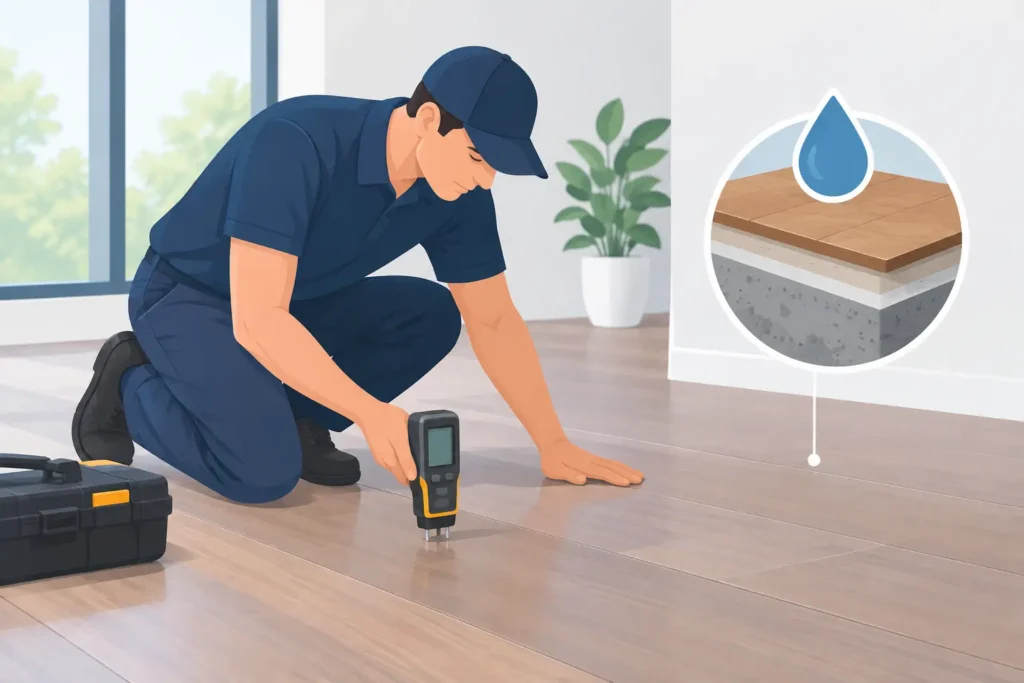
A beautiful floor can fail long before the first board is installed. Cupped hardwood, lifted vinyl planks, swollen laminate edges, and adhesive failures often trace back to one issue: moisture that was never properly measured. This flooring moisture testing guide explains what needs to be tested, why the results matter, and when it is smart to bring in a flooring professional before moving forward.
For Los Angeles homes and commercial spaces, moisture testing is especially relevant with concrete slab foundations, ground-floor rooms, remodels, and areas affected by plumbing leaks. A dry-looking slab or subfloor is not proof that it is ready for new flooring. The right test provides measurable information so material, underlayment, adhesive, and installation methods can be selected with confidence.
Flooring Moisture Testing Guide for Subfloors
Moisture testing is the process of measuring water vapor or moisture content in the surface beneath the flooring. The purpose is not to find a single universal “safe” number. Every flooring product and installation system has its own manufacturer requirements. Those requirements should guide the decision.
For example, a concrete slab may meet the requirements for one luxury vinyl plank adhesive but not for a glue-down hardwood system. A wood subfloor that is acceptable for engineered hardwood may still be too wet compared with the flooring boards delivered to the jobsite. That difference is why testing has to match both the subfloor and the material being installed.
Professional installers evaluate more than a moisture reading. They also look for visible staining, cracks, old adhesive residue, uneven areas, poor drainage, signs of a past leak, and conditions that could change after installation. A slab near an exterior door or below-grade wall may behave differently than the rest of the room. Testing several areas creates a more accurate picture than checking one convenient spot.
Concrete Slabs Need Moisture Vapor Testing
Concrete contains moisture by nature, and it can continue releasing water vapor long after it feels dry to the touch. This is a common issue in homes built on slabs, retail spaces, offices, and converted garages. Flooring installed over a slab must be able to handle the moisture conditions below it.
Two common professional test methods are relative humidity testing and calcium chloride testing. Relative humidity testing uses probes placed in drilled holes within the concrete. It measures moisture conditions inside the slab, where moisture movement begins. Calcium chloride testing measures the amount of moisture vapor released from the slab surface over a set period.
Neither method should be treated as interchangeable in every situation. Flooring and adhesive manufacturers may specify one test, the other, or both. Skipping the required method can create warranty problems even if the floor appears fine at first.
Moisture meter readings can also be useful as a screening tool, but they are not always enough on their own for a concrete installation. Handheld meters help identify areas that deserve closer evaluation. They do not replace a specified moisture vapor test when the flooring system requires documented results.
Wood Subfloors Require a Different Approach
Wood subfloors are tested for moisture content, usually with a pin or pinless moisture meter. Pin meters use small probes to measure moisture at a specific depth. Pinless meters scan the surface without puncturing it, which can be useful for quickly checking broader areas.
The key is comparing the moisture content of the wood subfloor with the moisture content of the flooring material. Solid hardwood is particularly sensitive to this relationship. If the subfloor is much wetter than the hardwood, the boards can absorb moisture after installation and expand. If conditions are too dry, gaps may develop later.
The acceptable difference depends on the product, board width, wood species, and manufacturer instructions. This is why a general internet rule should never override the flooring manufacturer’s installation requirements. Bamboo and engineered wood also need moisture checks, even though their construction can offer more dimensional stability than traditional solid hardwood.
What Testing Means for Each Flooring Type
Moisture testing protects every type of flooring, but the risks and solutions differ by material.
Hardwood requires the most careful planning. Solid hardwood is naturally responsive to changes in humidity, so the condition of the subfloor and the indoor environment both matter. In some cases, an engineered hardwood product is a better choice over concrete because of its layered construction. It is still not a license to ignore moisture testing.
Bamboo is an attractive, eco-conscious option for many homes, but it needs a stable installation environment. Quality bamboo flooring can perform well when the correct underlayment, moisture barrier, and acclimation process are used. Poor preparation can lead to movement, gapping, or damage regardless of how durable the material is marketed to be.
Laminate flooring has a core that can swell when exposed to excess moisture. Many modern products offer improved water resistance, but water-resistant is not the same as waterproof. Moisture from below can still affect seams, edges, and the locking system. A proper vapor barrier may be necessary over concrete, depending on the product and installation instructions.
Vinyl plank is often the practical choice for kitchens, offices, rentals, and busy households because it handles spills well. However, waterproof vinyl planks do not make a wet subfloor harmless. Excess vapor can weaken certain adhesives, contribute to mold concerns beneath the floor, or expose flaws in the substrate. Glue-down vinyl has especially specific moisture and pH requirements that must be checked before adhesive is applied.
When to Test and When to Wait
Moisture testing should happen after the subfloor is prepared and before flooring materials are installed. On a new concrete slab, the concrete must have enough curing time and the building should be operating under normal indoor conditions. Heating or air conditioning should be running as it normally will after occupants move in.
Testing should also be repeated after any event that may have introduced moisture. That includes a plumbing leak, overflowing appliance, roof leak, flood, or major water intrusion near exterior walls. Covering a compromised subfloor without identifying the source can trap the problem where it is harder and more expensive to repair.
Acclimating flooring material is another part of the process, but it is not a cure for a wet subfloor. Allowing wood, bamboo, or laminate to adjust to indoor conditions helps reduce sudden movement after installation. It does not eliminate moisture vapor rising from concrete or repair water-damaged plywood. Both the material and the subfloor have to be ready.
Common Shortcuts That Create Expensive Repairs
The most common mistake is relying on appearance. A slab can look clean and dry while still emitting more moisture vapor than an adhesive or flooring product can tolerate. Another mistake is assuming that a thick underlayment solves every moisture issue. Some underlayments are moisture barriers, but only when they are approved for the flooring system, installed correctly, and used within the product’s limitations.
Homeowners and property managers should also be cautious about installing new flooring immediately after removing carpet, tile, or old vinyl. The previous material may have hidden cracks, odors, moisture staining, adhesive residue, or uneven areas. Removing old flooring is the moment to inspect the substrate thoroughly, not rush to cover it again.
A professional evaluation is worth considering when results are borderline, readings vary sharply across a room, or there are signs of previous water damage. The right response may involve a moisture mitigation system, a vapor barrier, subfloor repair, a different flooring product, or simply more drying time. The most affordable solution depends on the actual condition, not a guess.
Plan for the Floor You Want to Keep
Moisture testing adds a step to the project, but it can prevent the far greater cost of removing and replacing a failed floor. It also helps homeowners and business owners choose materials that fit the room, the subfloor, and the budget from the start.
At Magnet Flooring, careful site evaluation is part of delivering flooring that looks right and performs over time. Before committing to hardwood, bamboo, laminate, or vinyl plank, ask how the subfloor will be tested and what the results mean for your chosen product. A clear answer now can protect your investment for years.